Internal Validation
Summary
| Metric | Value |
|---|---|
| Total Tests | 10 |
| Passed | 10 |
| Failed | 0 |
| Pass Rate | 100% |
Test Methodology
Each test case is validated against independent calculations using:
- Psychrometric properties: ASHRAE correlations for saturation pressure, humidity ratio, and moist air enthalpy
- Merkel integration: 4-point Chebyshev quadrature (CTI standard) as an independent reference
- Energy balance: Q_water = mw * Cpw * Range vs. Q_air = ma * (h_a,out - h_a,in)
Test Cases
Case 1: Design/Poppe — Classic (L/G = 1.0)
| Parameter | Value |
|---|---|
| Tw,in / Tw,out | 40 / 30 °C |
| Tdb / Twb | 25 / 20 °C |
| L/G | 1.0 |
| mw | 0.278 kg/s |
Results: Tw,out = 30.00 °C, Q = 11.60 kW, KaV/L = 0.8144, Evap = 0.00393 kg/s
Case 2: Design/Merkel — Classic (L/G = 1.0)
Same inputs as Case 1, but using Merkel method.
Results: KaV/L = 0.8030 (1.4% lower than Poppe — expected due to Le_f assumption)
Case 3: Rating/Poppe — Round-Trip from Case 1
Using KaV/L = 0.8144 from Case 1 as input.
Results: Tw,out = 30.00 °C (0.00 K deviation — perfect round-trip)
Case 4: Rating/Merkel — Round-Trip from Case 2
Using KaV/L = 0.8144 as input.
Results: Tw,out = 29.93 °C, Q = 11.68 kW
Case 5: Design/Merkel — High L/G = 2.0
| Parameter | Value |
|---|---|
| Tw,out target | 32 °C |
| L/G | 2.0 |
Results: KaV/L = 0.7166
Case 6: Design/Merkel — Low L/G = 0.5
| Parameter | Value |
|---|---|
| Tw,out target | 28 °C |
| L/G | 0.5 |
Results: KaV/L = 0.9767
Case 7: Design/Poppe — Narrow Approach (2 K)
| Parameter | Value |
|---|---|
| Tw,in / Tw,out | 35 / 22 °C |
| Twb | 20 °C |
| Approach | 2 K |
Results: KaV/L = 6.9055 (very high — extreme condition)
Case 8: Design/Merkel — Wide Range (20 K)
| Parameter | Value |
|---|---|
| Tw,in / Tw,out | 50 / 30 °C |
| Tdb / Twb | 30 / 25 °C |
| L/G | 1.5 |
Results: KaV/L = 2.7417
Case 9: Rating/Poppe — Higher Flow (1 kg/s)
| Parameter | Value |
|---|---|
| Tw,in | 40 °C |
| KaV/L | 1.5 |
| L/G | 1.0 |
Results: Tw,out = 27.11 °C, Q = 53.84 kW
Case 10: Design/Merkel — Flow Consistency Check
Same conditions as Case 1 but with mw = 1.0 kg/s to confirm the KaV/L is flow-independent.
Cross-Validation: Poppe vs Merkel
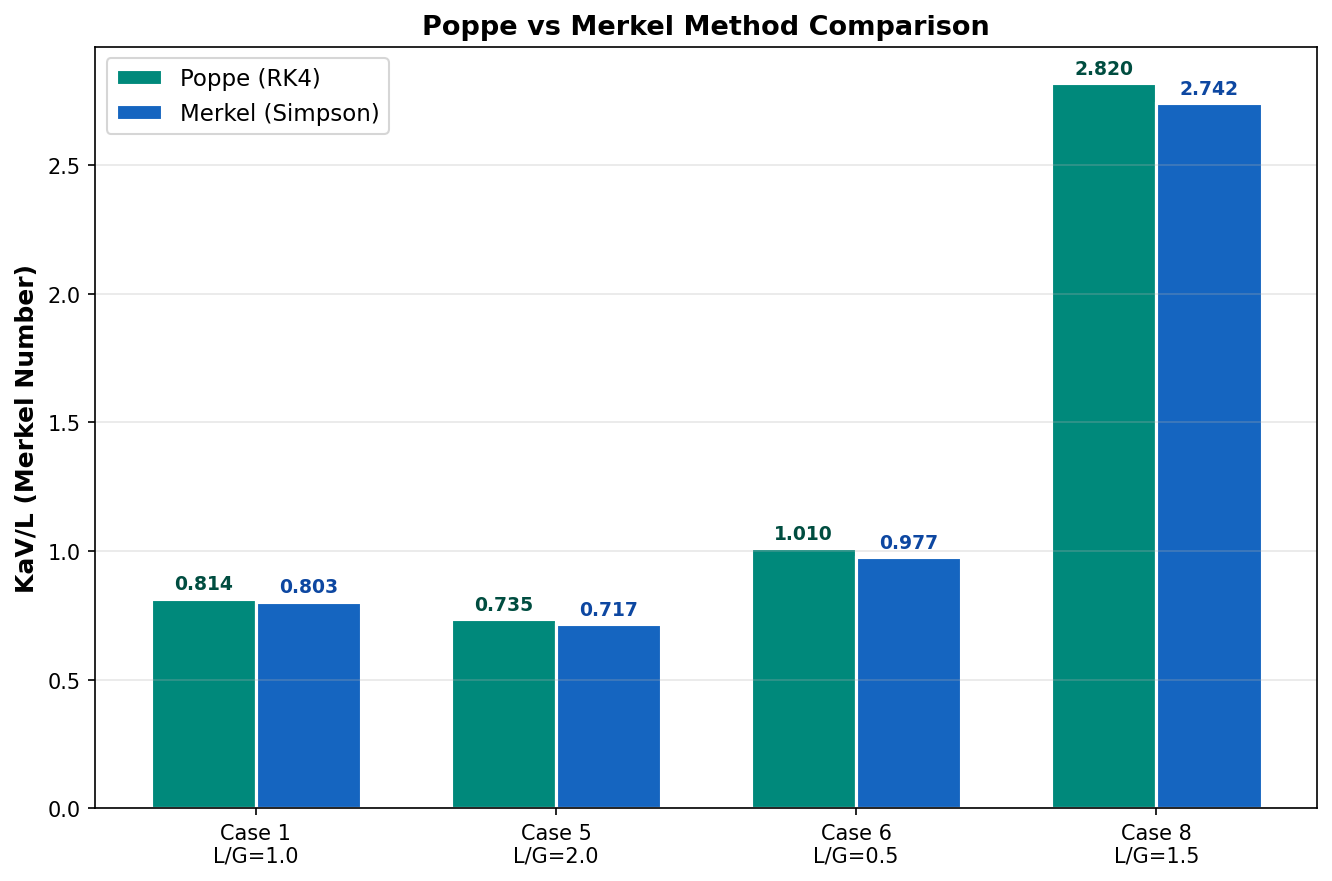
| Comparison | Poppe | Merkel | Difference |
|---|---|---|---|
| KaV/L (L/G=1.0) | 0.8144 | 0.8030 | +1.4% |
| Q rejected | 11,602 W | 11,602 W | 0.0% |
| Air outlet T | 32.35 °C | 25.28 °C | +7.1 K |
| Air outlet w | 0.02693 | 0.02904 | -7.3% |
Expected Differences
The Poppe method predicts higher air outlet temperatures because it properly accounts for the Lewis factor, resulting in a more accurate air-side energy balance. The Merkel method, by assuming Le_f = 1, overestimates the humidity ratio increase and underestimates the temperature rise.
Energy Balance Verification
For all 10 test cases, the energy balance was verified:
where:
- \( Q_{water} = \dot{m}_w \cdot c_{pw} \cdot (T_{w,in} - T_{w,out}) \)
- \( Q_{air} = \dot{m}_a \cdot (h_{a,out} - h_{a,in}) \)
All cases passed this criterion.
Design-Rating Round-Trip
The round-trip test (Design produces KaV/L, Rating uses it to recover Tw,out) was verified with 0.00 K deviation for both methods.